Workshop · Orbits 01 & 04 · Astrodynamics & Zero-Glue Native Graphics
Titan as Cassini's Engine — and Zero-Glue 3D Rendering in Compiled Titan
Hyperbolic gravity-assist kinematics proving why 127 Titan flybys replaced dozens of main-engine burns, paired with a 6-module playable 3D Saturn–Titan showcase written in Titan against SDL3 and Cairo with zero custom C glue.
1. Why Geometry Beats Propellant (127 Close Flybys)
Titan's 5,150 km diameter makes it larger than Mercury and massive enough (μTitan = 8,978.14 km3 s−2) to serve as Cassini's real propulsion system. For a hyperbolic flyby at closest-approach radius rp = RTitan + h and arrival excess speed v∞, the eccentricity is e = 1 + rpv∞2/μTitan, bending the trajectory by δ = 2 arcsin(1/e) and delivering a free Saturn-frame impulse Δv = 2v∞/e.
At 880 km altitude during T70, Titan deflected Cassini by 8.78° and delivered 857.1 m/s — 1.37× Cassini's entire 90-minute main-engine Saturn Orbit Insertion burn (626 m/s) — without expending a drop of hydrazine.
flyby.titan. Every close targeted pass below ~1,750 km outperformed the
spacecraft's 90-minute arrival engine burn.
| Pass | Date | Alt (km) | v∞ | Turn | Δv (m/s) | vs. SOI | Mission Milestone |
|---|---|---|---|---|---|---|---|
TA | 2004-10-26 | 1,174.0 | 6.07 | 7.00° | 741.0 | 1.18× | First close targeted flyby |
T16 | 2006-07-22 | 950.0 | 5.95 | 7.70° | 798.7 | 1.28× | First northern hydrocarbon lakes radar pass |
T70 | 2010-06-21 | 880.0 | 5.60 | 8.78° | 857.1 | 1.37× | Deepest atmospheric skim (880 km) |
T126 | 2017-04-22 | 979.0 | 5.83 | 7.93° | 806.7 | 1.29× | Last close pass; vault into Grand Finale |
T-127 | 2017-09-11 | 119,049.0 | 5.80 | 0.25° | 25.4 | 0.04× | Distant goodbye kiss into Saturn |
2. Cassini: Grand Tour — Compiler-Enforced Thin FFI Against SDL3 & Cairo
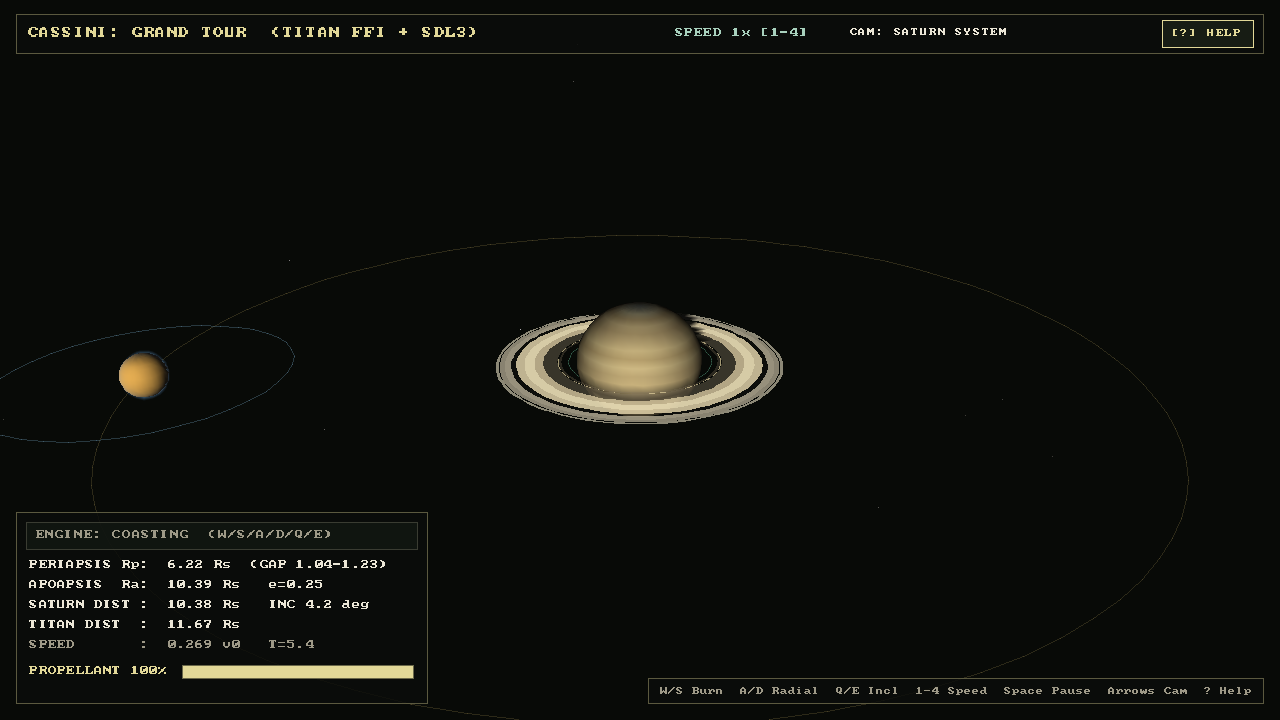
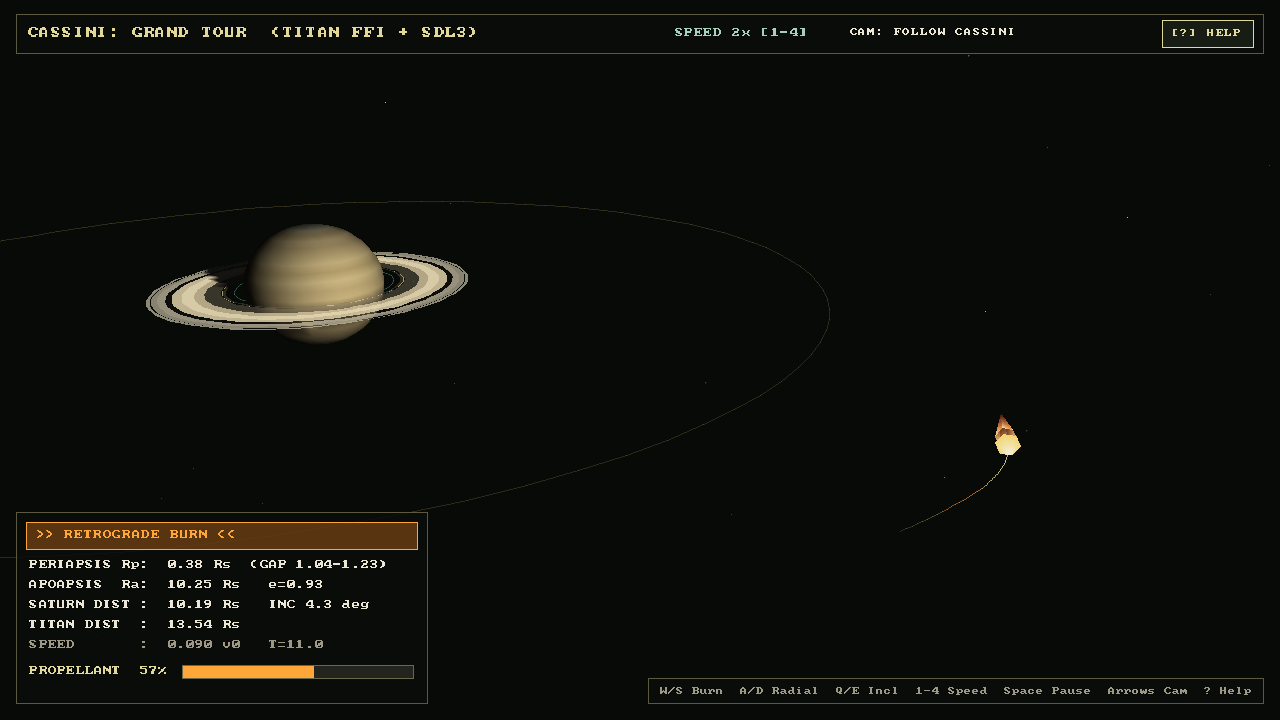
To stress-test how thin foreign boundaries feel in practice, I built a 6-module interactive 3D gravity-assist
simulator (math3d, sim, scene, hud, gfx,
main) linked straight against <SDL3/SDL.h> and <cairo/cairo.h>
with zero C wrapper files. Titan owns the Velocity Verlet Saturn + J2 + Titan
physics, perspective projection, oblate Saturn cloud-band shading, 10-band analytical ring shadows, detached
Titan haze halo, painter's sort, and HUD.
Only gfx.titan imports C headers. Titan's type system enforces the boundary automatically:
trying to export a header-defined C pointer on a public record fails at compile time, keeping C handles
strictly in module-private local fields with gc.finalizable teardown backup while
the other five modules stay 100% portable, header-free Titan.
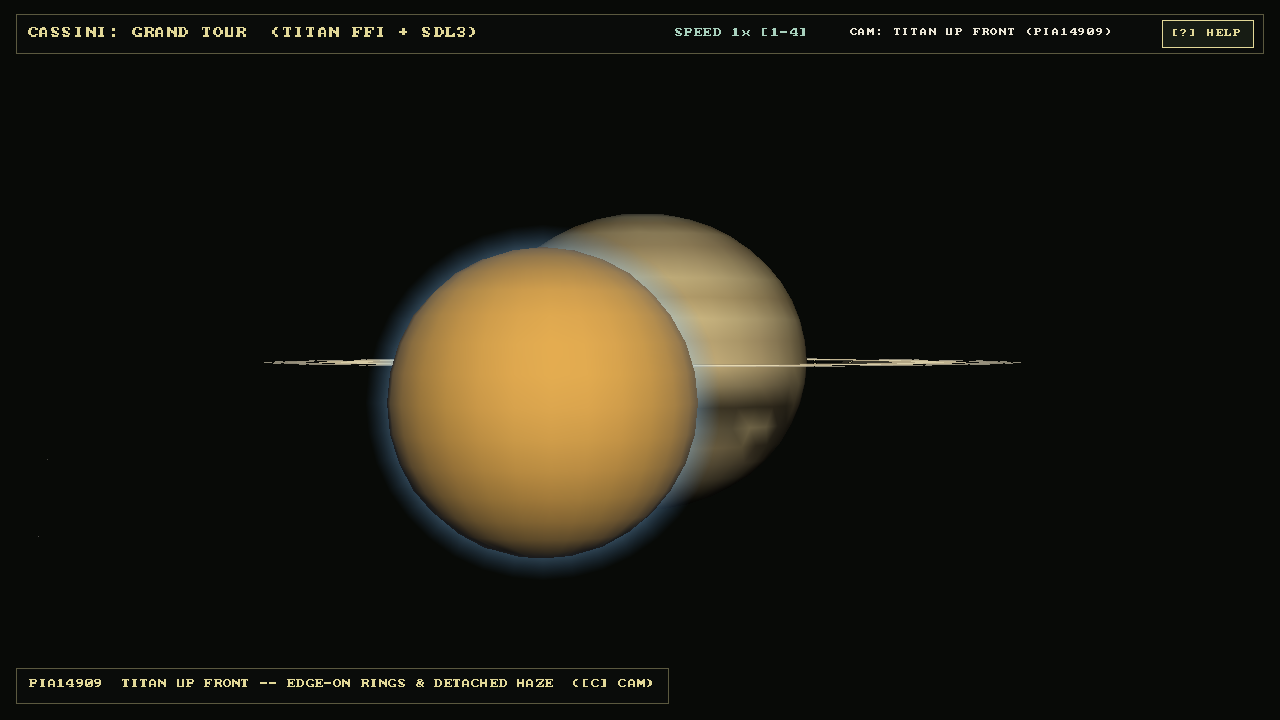
SDL_RenderGeometry and exported with Cairo:
golden-amber tholin Titan wrapped in its detached pale-blue upper haze (PIA06122) crossing oblate
banded Saturn and its edge-on ring plane.